



This project was selected for funding under the University of Haifa’s Impact Research Initiative (2024–2025) and supported by a NIS 50,000 grant from the Innovation and Sustainability Division.
The awarded research reflects the University’s leadership in shaping a more sustainable future, positioning academic research as a catalyst for social responsibility, environmental resilience and long-term impact.
Israel faces an acute waste-management challenge: nearly 78% of municipal solid waste is landfilled, compared to an average of just 35% across OECD countries in Europe. This heavy reliance on landfill contributes significantly to greenhouse gas emissions and the release of carcinogenic pollutants, turning waste treatment into a pressing environmental and social issue.
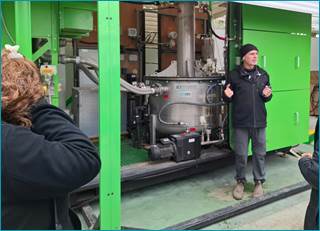
A new research project led by PhD candidate Sara Malka Or, under the supervision of Prof. Ofira Ayalon and Dr. Ruslana Rachel Palatnik, is exploring the economic, social, and environmental feasibility of small-scale, mobile waste-to-energy (WtE) facilities based on gasification technology. Compared to direct incineration and landfilling, gasification offers clear environmental advantages, including substantially reduced pollutant emissions.
The research focuses on decentralized solutions located close to waste-generation sites, with the potential to significantly cut transportation costs, reduce environmental damage, and decrease landfill volumes by more than 88%, while producing usable by-products. The study also examines the critical role of collaboration between local authorities, central government and the private sector, as well as strategies for addressing regulatory barriers and public opposition (NIMBY).
By bridging research, policy and implementation, the University of Haifa is turning environmental science into real-world impact, advancing circular economy solutions and building a more sustainable future for Israel.